Japanese Nakiri Knives
A nakiri is the dedicated Japanese vegetable knife: a tall, rectangular blade with a flat, double-bevel edge that drops straight down through onions, cabbage and carrots so the whole edge meets the board and every cut lands clean, with no tearing or half-slices. It is fast, forgiving and easy to sharpen, which is what makes it the knife serious cooks reach for on a big pile of prep. Our range runs to 34 nakiri knives, from $129.95.
-
 $359.95
 -
 $369.00
 -
$209.95
$229.95








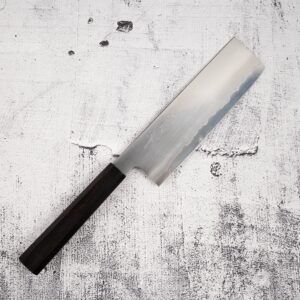
Nakiri knife specifications
| Specification | Detail |
|---|---|
| Blade type | Flat, rectangular double-bevel vegetable knife |
| Typical length | 165 to 180 mm |
| Edge | Double bevel, symmetrical and easy to sharpen |
| Best for | Vegetables, herbs and clean straight push cuts |
| Avoid | Bone, frozen food and hard squash rind |
| Steel options | Stainless (VG10, Ginsan) and carbon (White, Blue) |
Nakiri knife facts
34 nakiri knives in stock here, with prices from $129.95 to $649.00. The flat edge sits flush on the board for clean push cuts, and the symmetrical double bevel keeps the knife easy to use and easy to sharpen. It is a vegetable knife, so keep it off bone and frozen food where the thin edge can chip.
How to use a nakiri knife
A nakiri works best with a straight up-and-down push cut rather than a rocking motion. Line the flat edge over the food, press straight down and let the tall blade do the work, then use the broad face to scoop cut vegetables off the board. Keep it off bone and frozen food, wipe it dry after each use, and touch up the edge on a whetstone when it starts to slow.
Nakiri knives in stock
Masutani VG1 Tsuchime 165mm Black Chacate Handle — $129.95
K&S VG10 Tsuchime Sanmai 180mm Western Handle — $155.95
Masutani Kokuryu VG10 Damascus 165mm Black Chacate Handle — $159.95
Tsunehisa Ginsan Nashiji 165mm Ebony Handle — $189.95
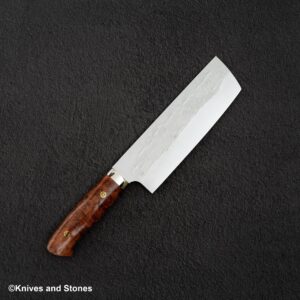
Hatsukokoro Hayabusa Aogami Super K-tip 180mm — $209.95
Anryu Aogami Super Hammered Kurouchi 165mm Ebony Handle — $254.99
Matsubara Blue 2 165mm Nashiji Burnt Kashi — $298.00
Katsushige Anryu Blue 2 Tsuchime 170mm Stainless Clad Ebony Handle — $299.95
Mazaki White 2 Kurouchi 180mm — $339.95
Kurosaki Senko Ei SG2 165mm Ebony — $339.95
Yoshikane White 2 Nashiji Stainless Clad 165mm Ebony Handle — $339.99
Shiro Kamo Kurokumo SG2 Black Damascus 180mm Ebony — $349.95
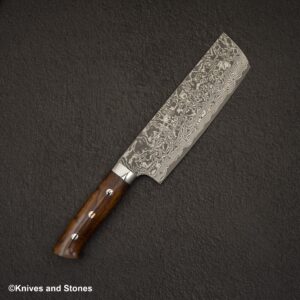
Nigara SG2 Tsuchime Matt Migaki K tip 180mm Ebony Handle — $359.95
Kei Kobayashi SG2 165mm — $359.95
Kurosaki Fujin SG2 165mm — $369.00
Masakage Yuki White2 Stainless Clad 165mm — $369.95
Yoshimi Kato Kintaro Minamo SG2 165mm Ebony — $369.95
Matsubara Blue 2 K-tip Sujihiki 240mm Nashiji Burnt Kashi — $394.00
Yu Kurosaki Shizuku SG2 165mm — $399.95
Tetsujin Blue 2 Kasumi 180mm Ebony Handle — $429.95
Hatsukokoro Hayabusa HAP-40 Damascus 165 mm with Western Handle — $449.00
Shibata Koutetsu Chromax Boss 175mm, Ebony White Ring Handle — $449.95
Shibata Koutetsu Chromax Boss 175mm, Ebony Black Ring Handle — $449.95
Hatsukokoro Ginsan Damascus Tsuchime 170 mm with Teak wood Handle, by Yoshihiro — $475.00
Masakage Koishi AS 165mm, Aogami Super Kurouchi Tsuchime K&S Hearted-shaped Iron — $479.95
Hatsukokoro Ginga ATS34 Damascus 165mm — $499.00
Tetsujin Ginsan Ukiba 180mm Ebony Handle — $499.95
Takeshi Saji VG10 Rainbow Damascus 165mm Ebony Handle Mosaic Pin — $529.95
Hatsukokoro Shinkiro Aogami Super Kurouchi Damascus 165mm — $529.95
Takeshi Saji SRS13 165mm Western Amboyna Handle — $599.95
Myojin Riki Seisakusho SG2 Kasumi 180mm Ebony Handle — $599.95
Takeshi Saji SG2 Black Damascus 175mm Ironwood — $629.95
Nigara SG2 Tsuchime K-tip 165mm Kurouchi Western Ironwood — $629.95
Takeshi Saji SG2 Black Damascus 175mm Stag Handle — $649.00
Nakiri knife questions
What is a nakiri knife used for?
It is used for vegetable preparation, slicing, chopping and dicing with clean straight push cuts. The flat edge and tall blade also make it easy to scoop cut produce off the board.
What is the difference between a nakiri and a santoku?
The nakiri is flat with a square tip and is dedicated to vegetables; the santoku has a rounded tip and works as an all-purpose knife across vegetables, meat and fish.
What are the disadvantages of a nakiri?
It is not suited to rocking cuts, the square tip limits detailed and piercing work, and the thin edge can chip on bone or frozen food.
What is the difference between a chef knife and a nakiri?
A Western chef knife is longer and curved for rocking and is more versatile; the nakiri is flat, thin and specialised for clean vegetable cuts.
What is the difference between a nakiri and an usuba?
Both are flat Japanese vegetable knives, but the nakiri is double-bevelled and easy for anyone to use, while the usuba is single-bevelled, sharper for fine work and needs more skill to sharpen.
Related Japanese knife ranges
Related ranges: Japanese santoku knives, usuba knives, Japanese whetstones and the Knives and Stones range. New to these knives? See our guides on what a nakiri knife is and nakiri vs santoku.